
How many demonstrations are enough?
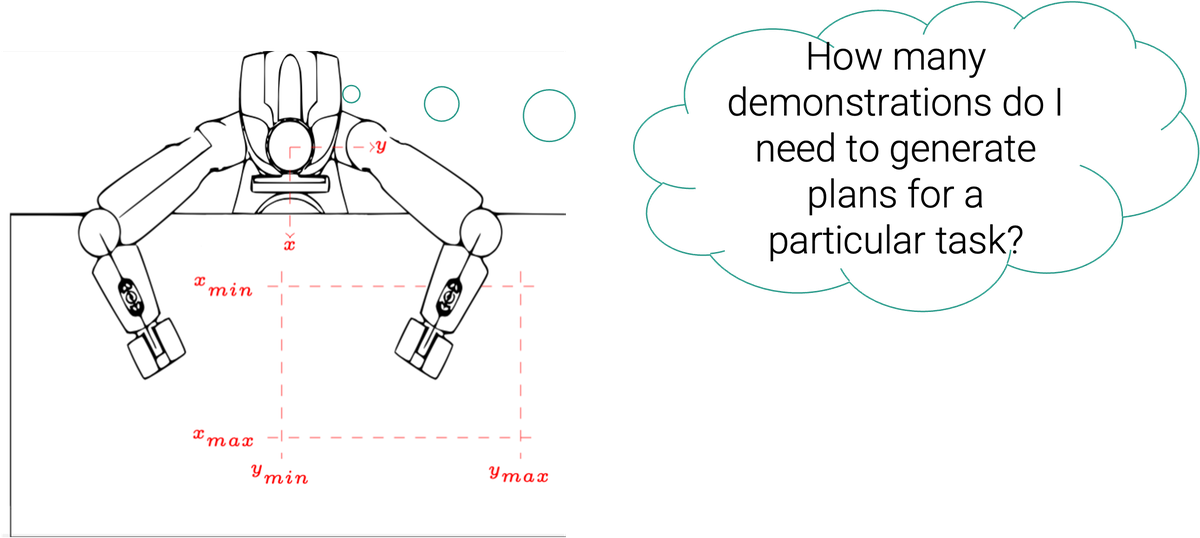
Letting the robot evaluate its own plans and ask for kinesthetic demonstrations incrementally, so it can pour and scoop reliably over a region of its workspace with as few demonstrations as possible.
IEEE International Conference on Robotics and Automation (ICRA), 2026. D. Das, A. Patankar, N. Chakraborty, C.R. Ramakrishnan, and I.V. Ramakrishnan.
The problem
Kinesthetic demonstrations are an easy way to teach a robot tasks like pouring and scooping, but each one takes time, and the person teaching has no good way of knowing how many are needed. A demonstration given in one part of the workspace may not be enough for the task to succeed everywhere the robot needs to do it.
Approach
Each demonstration is represented as a sequence of constant screw motions, which can be used to generate motion plans for new positions of the objects with screw linear interpolation (more on this). The robot evaluates these plans itself over a specified region of its workspace, and demonstrations are acquired incrementally, only where the existing ones are not enough. The self-evaluation draws on multi-armed bandits, and the aim is the minimal set of demonstrations needed to perform the task reliably over that region.
Experiments
We evaluated the approach on pouring and scooping with a Baxter robot.
Papers
Screw Geometry meets Bandits: Incremental Acquisition of Demonstrations to Generate Manipulation Plans
IEEE International Conference on Robotics and Automation (ICRA), Vienna, Austria, 2026
Transferring Kinesthetic Demonstrations across Diverse Objects for Manipulation Planning
IEEE/RSJ International Conference on Intelligent Robots and Systems (IROS), Hangzhou, China, 2025
Screw Geometry meets Bandits: Incremental Acquisition of Demonstrations for Generating Manipulation Plans
Late Breaking Results Poster, Manipulation and Grasping Session, IEEE/RSJ International Conference on Intelligent Robots and Systems (IROS), Detroit, MI, USA, 2023