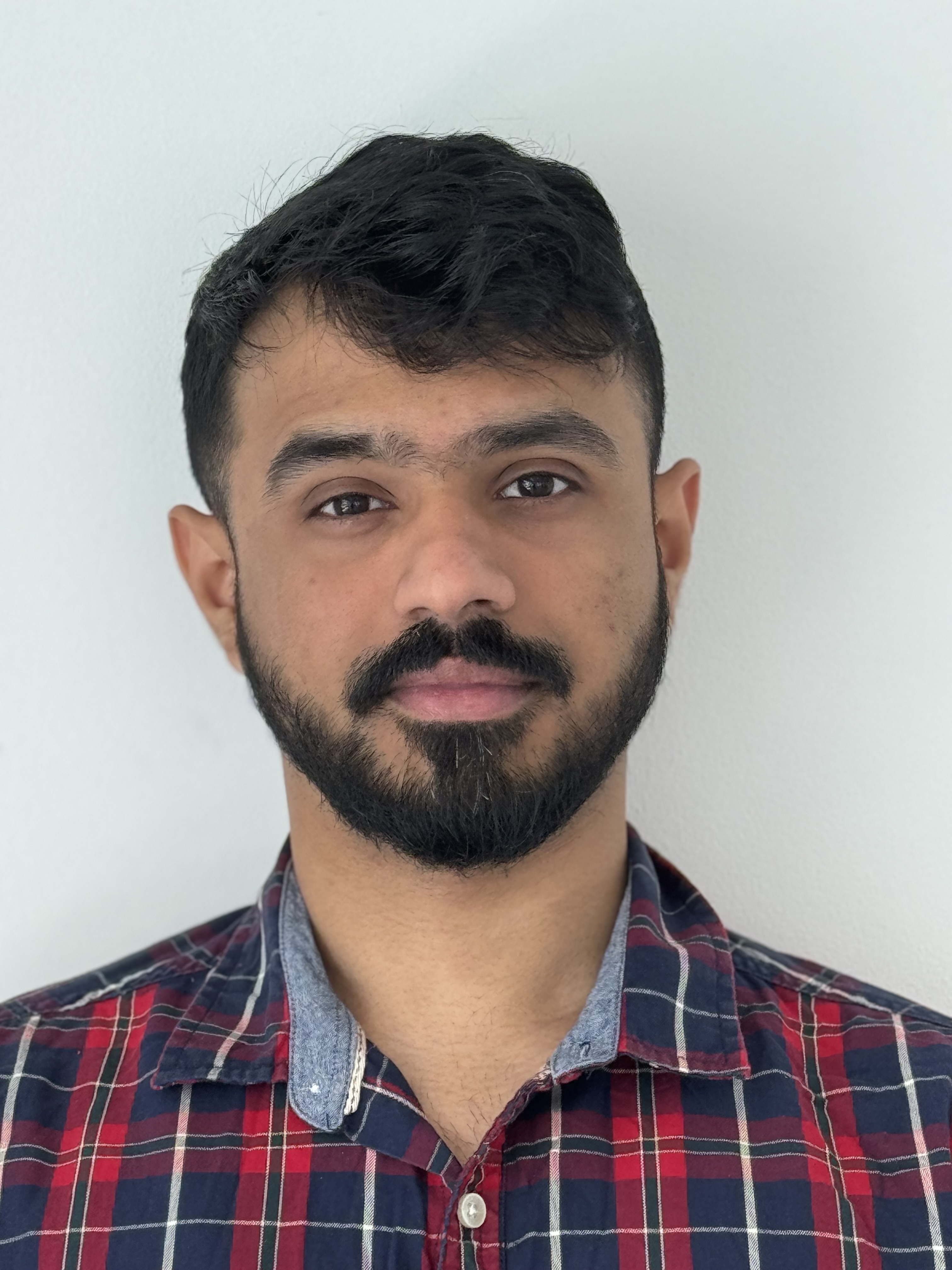
About Me
I am a Postdoctoral Associate in the Soft Flyers Group at Stony Brook University, New York, where I work on multimodal aerial and underwater robots, along with robotic manipulation and planning. I completed my PhD at the Interacting Robotic Systems Laboratory at Stony Brook, advised by Dr. Nilanjan Chakraborty, with a thesis on Sensor-Based Task-Oriented Grasping. My primary research interests are robotic manipulation and motion planning. More broadly, I study how manipulation tasks are specified and represented, and what that means for planning and learning-based approaches alike. I envision a future where robots work alongside humans, performing a repertoire of tasks beyond just pick and place operations. My research goal is to develop algorithms and technologies enabling robots to achieve this vision.
During my PhD, I worked on several projects aimed at advancing the state-of-the-art in robotic manipulation, motion planning, and grasp synthesis. I also worked on developing solutions to real-world problems in healthcare (assistive robotics) and agriculture (containerized vertical farming using cobots). Towards the end of my PhD, I started exploring how foundation models (VLMs and LLMs) can be used for robotic manipulation. Please visit the Research and Publications sections for more information.
During the summer of 2025, I interned at GE Aerospace Research as a Robotics and Embodied AI PhD Fellow in the Autonomous Systems Research group. I evaluated NVIDIA’s robotics stack (cuRobo and FoundationPose) for high-mix low-volume industrial automation and built a perception-driven motion planning framework for autonomously scanning tubes and ducts.
During the summer of 2024, I had the opportunity to intern at Nokia Bell Labs as part of the Modelling and Optimization Group where I was mentored by Dr. Jeongran Lee and Dr. Matthew Andrews. I worked on building 3D representations for dynamic digital twins of indoor environments using radiance field techniques with various camera sensors. This valuable experience enhanced my skills in computer vision, deep learning, and data collection in real-world environments.
Feel free to reach out to me if you are interested in my work, would like to collaborate, or if you need a reviewer for ICRA, IROS, TRO or RAL!
Code
tograsp-socp: Python implementation of our task-dependent grasp metric, formulated as a second-order cone program.
PyScLERP: Python implementation of Screw Linear Interpolation (ScLERP) for manipulation planning, with examples such as pivoting and sliding.
Task-Oriented Grasping from Point Cloud Representation: neural network-based task-oriented grasp synthesis on object point clouds (IROS 2023).
Updates
Aug 2026: I joined the Soft Flyers Group at Stony Brook University as a Postdoctoral Associate, working on multimodal aerial and underwater robots.
July 2026: I completed my PhD at Stony Brook University! My thesis, “Sensor-Based Task-Oriented Grasping”, is available online.
June 2026: Our paper “Screw Geometry meets Bandits: Incremental Acquisition of Demonstrations to Generate Manipulation Plans” appears at IEEE ICRA 2026 in Vienna, along with our workshop paper “Active Perception for Autonomous Multi-View Geometrically Consistent Data Collection in Local Environments” at the Workshop on Learning and Representations for Active Perception in Manipulation.
June 2025: Our work on “Transferring Kinesthetic Demonstrations across Diverse Objects for Manipulation Planning” has been accepted at IEEE/RSJ IROS 2025! Kudos to everyone involved!
June 2025: I will be joining GE Aerospace Research as a Robotics and Embodied AI PhD Fellow intern in Autonomous Systems Research group. Looking forward to an exciting summer!
April 2025: Our work on ‘Task-dependent Grasp Metric with Object and Manipulator Dynamics’ has been accepted in the ‘Late Breaking Results’ category at ICRA 2025.
Mar 2025: If you are not familiar with using Screw Linear Interpolation (ScLERP) for task space path planning of manipulation tasks with constraints please check out this repository. NOTE: This repository is under development and we are working on including additional examples and functionality. Feel free to reach out if you have any questions.
Jan 2025: 2 Papers accepted at ICRA 2025 - “Synthesizing Grasps and Regrasps for Complex Manipulation Tasks” and “Point Cloud Decomposition for Task-Oriented Grasping”. Congratulations to all the authors!
Nov 2024: Our paper “Design and Kinematic Analysis of a Novel Series-Parallel Hybrid Finger for Robotic Hands” has been published in ASME Journal of Mechanisms and Robotics!
Oct 2024: My colleague Dasharadhan Mahalingam presented our paper on “A General Formulation for Path Constrained Time-Optimized Trajectory Planning with Environmental and Object Contacts” at IROS 2024 in Abu Dhabi.