
Motion planning from demonstrations
Extracting the constraints of a task like pouring or scooping from a kinesthetic demonstration, and reusing them for new object positions, new objects, and harvesting in vertical farms.
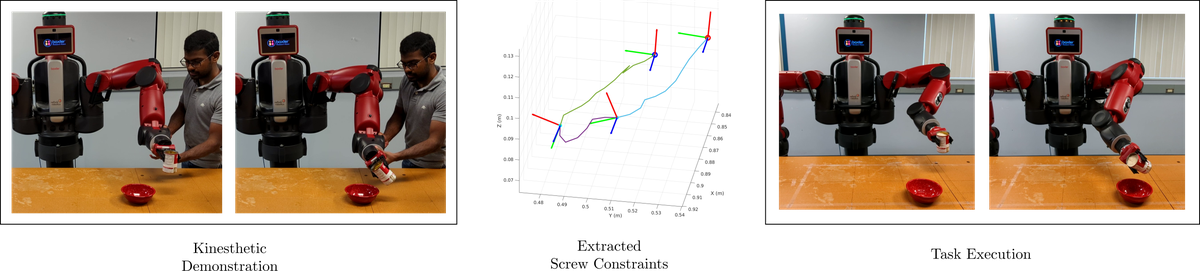
Representing complex manipulation tasks, like scooping and pouring, as a sequence of constant screw motions in SE(3) allows us to extract the task-related constraints on the end-effector’s motion from kinesthetic demonstrations and transfer them to new instances of the same task. The motion plans are computed with screw linear interpolation (ScLERP), which satisfies these constraints kinematically.
We have evaluated this approach on scooping and pouring, and in containerized vertical farms for transplanting and harvesting leafy crops.
We have also developed an approach to transfer the task-related constraints between objects that are functionally similar but have different geometries. The notion of functional similarity is captured by a knowledge base.
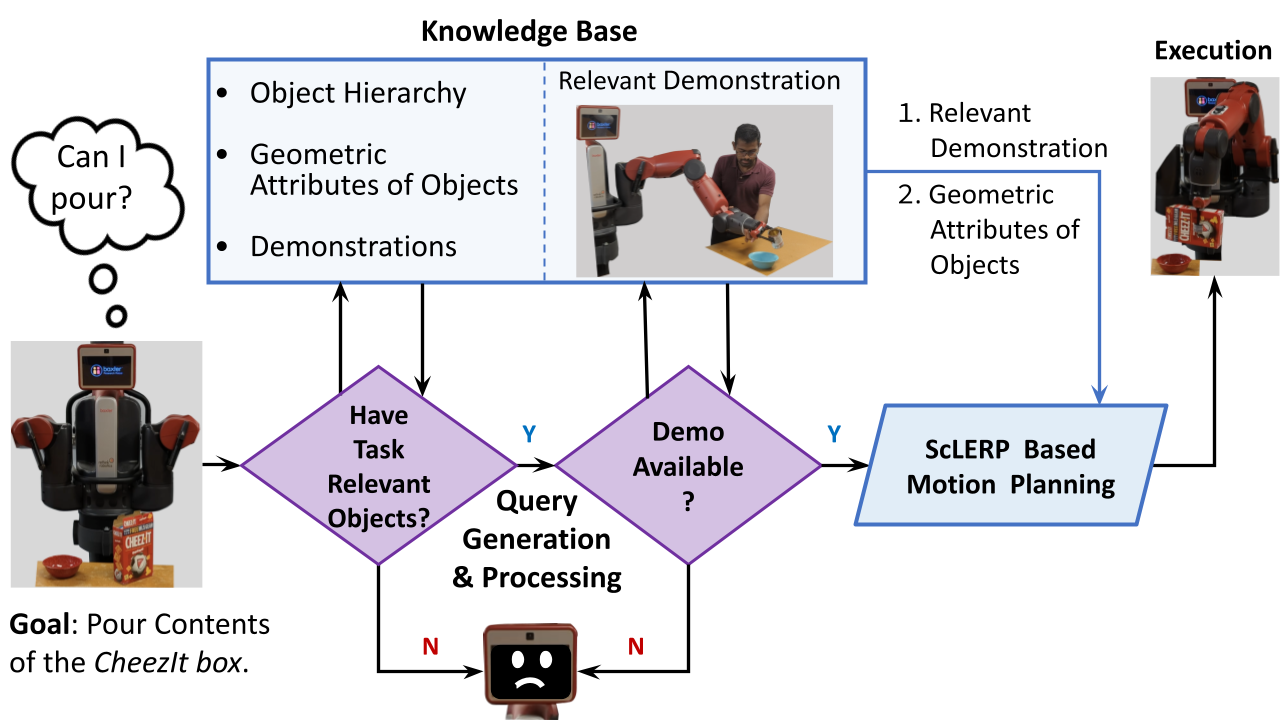
More recently, we developed a self-evaluation-based approach that lets the robot compute the minimal set of kinesthetic demonstrations needed to perform tasks like pouring and scooping reliably over a region of its workspace. See How many demonstrations are enough?
Papers
Transferring Kinesthetic Demonstrations across Diverse Objects for Manipulation Planning
IEEE/RSJ International Conference on Intelligent Robots and Systems (IROS), Hangzhou, China, 2025
Containerized Vertical Farming Using Cobots
IEEE International Conference on Robotics and Automation (ICRA), Yokohama, Japan, 2024
Caregiver-Guided Robotic Manipulation to Promote Independence of People with Significant Locomotor Disability
Workshop on Assistive Robotics for Citizens, IEEE/RSJ International Conference on Intelligent Robots and Systems (IROS), Detroit, MI, USA, 2023
Knowledge-Enabled Motion Generation for Complex Manipulation Tasks
Workshop on Geometric Representations: The Roles of Screw Theory, Lie Algebra, and Geometric Algebra, IEEE International Conference on Robotics and Automation (ICRA), London, UK, 2023