
Grasps and regrasps for multi-step tasks
Deciding whether one grasp can carry out a whole manipulation plan, and where the robot needs to regrasp when it can't.
IEEE International Conference on Robotics and Automation (ICRA), 2025. A. Patankar, D. Mahalingam, and N. Chakraborty.
The problem
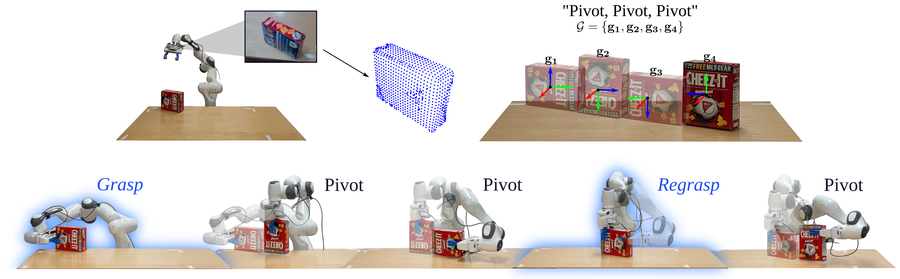
Many tasks are more than one motion. Pivoting a box several times in a row is a sequence of constant screw motions, and a grasp that works for the first motion may not work for a later one. The robot needs to know whether a single grasp will do for the whole plan, and if not, where to regrasp and which grasps to use.
Approach
We formalize regrasping in terms of the task. Starting from the object’s point cloud and a manipulation plan given as a sequence of constant screw motions, we use the task-dependent grasp metric to find which grasps can impart each motion. From this we compute whether a single grasp is enough for the whole plan or the robot needs to regrasp along the way, and synthesize the grasps.
Experiments
We ran the approach on a Franka Emika Panda. The clip at the top shows two trials, sped up 8×.
Papers
Synthesizing Grasps and Regrasps for Complex Manipulation Tasks
IEEE International Conference on Robotics and Automation (ICRA), Atlanta, GA, USA, 2025
Task-Oriented Grasping with Point Cloud Representation of Objects
IEEE/RSJ International Conference on Intelligent Robots and Systems (IROS), Detroit, MI, USA, 2023
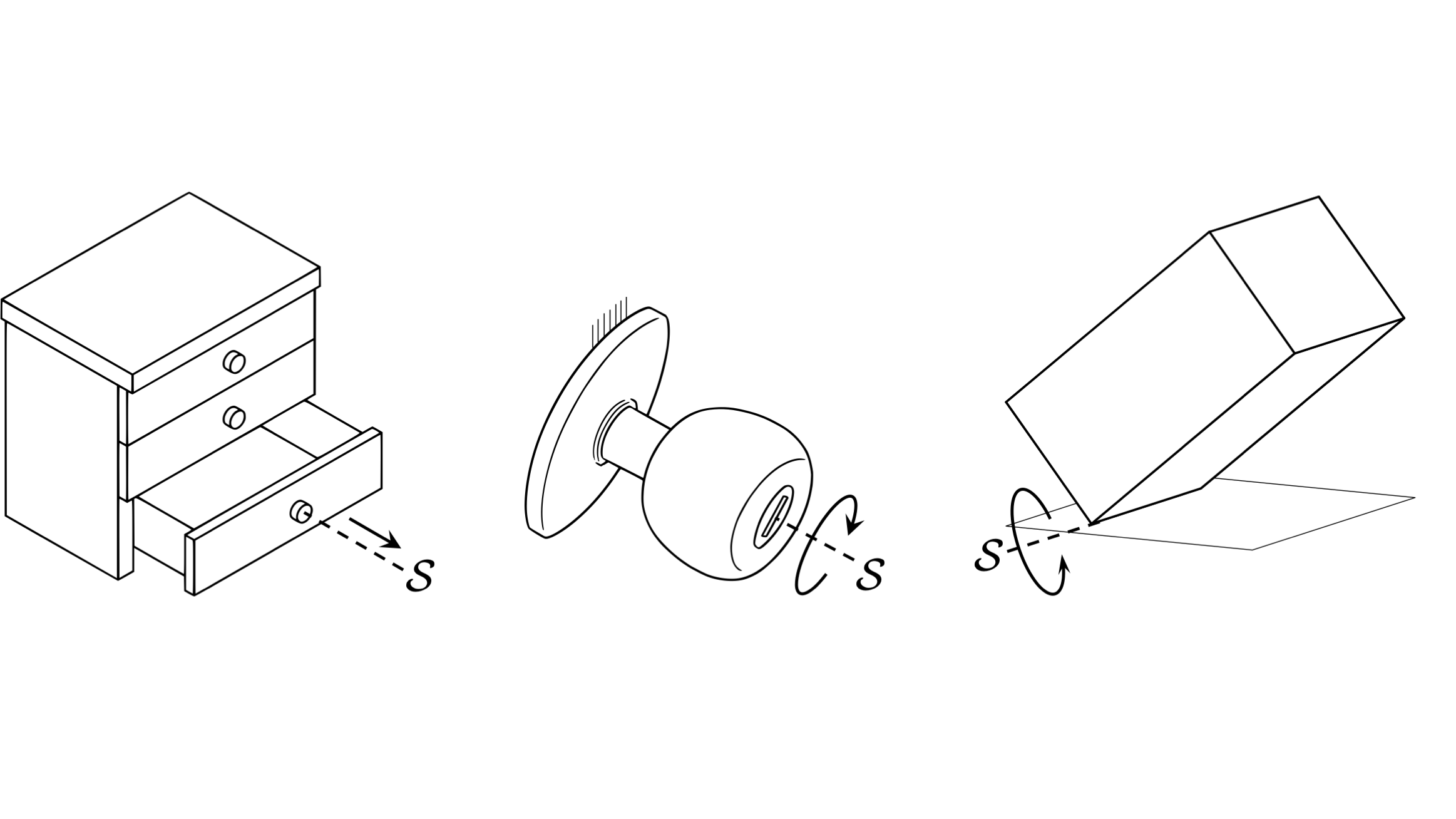
Computing a Task-Dependent Grasp Metric Using Second-Order Cone Programs
IEEE/RSJ International Conference on Intelligent Robots and Systems (IROS), Prague, Czech Republic, 2021